
|
Getting your Trinity Audio player ready...
|
Not that I am speaking of being in need, for I have learned, in whatever situation I am, to be content (Philippians 4:11, ESV, emphasis added).
The Greek word for “contentment” is found only three times in the New Testament, not only in Philippians 4:11 (listed above) but in…
And God is able to make all grace abound to you, so that having all sufficiency [contentment] in all things at all times, you may abound in every good work (2 Corinthians 9:8).
and…
But godliness with contentment is great gain (1 Timothy 6:6).
I’ve read these passages for years and usually feel guilty afterward because I’m often not content. I’ve asked, “Is my having ambition and trying to improve things lacking contentment?” and “When I see injustice or lack funds for Kingdom purposes, is my concern lacking contentment?”
The Greek word “autarkēs” means “contentment” or “self-sufficiency,” which needs explaining, since “self-sufficiency” through our own effort never works, and Christians should depend on God.
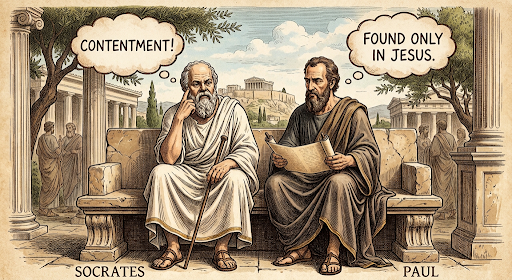
What the Apostle Paul means when he discusses “contentment” gets interesting when we consider the cultural context of “autarkēs.” First, let’s get a lesson in philosophy…
“Have you ever heard of Stoicism?”
Long before Paul’s lifetime, the Greek philosopher Socrates (470 to 399 B.C.) used this word to sum up his beliefs, equating true freedom with needing less, not accumulating wealth, minimizing physical desires, and generally being a killjoy to the power-grabbing, chateau-owning crowd of his day. And they brought him to trial for his teachings, claiming he was following new gods and corrupting youth.
After a farcical trial, Socrates was condemned to death, with his request that he save the authorities their time and effort and do it himself by drinking poison. Which he did.
After the death of Socrates, a buzzword began to circulate in Athenian and later Roman culture, and that buzzword was — drum roll — “autarkēs,” rooted in Socrates, promoted by the Stoics as a “self-help” philosophy and then used by the Apostle Paul when he wrote, “I have learned, in whatever situation I am, to be content [autarkēs].”
Paul took the Stoic philosophy of “autarkēs,” turning it upside down by adding…
I know how to be brought low, and I know how to abound. In any and every circumstance, I have learned the secret of facing plenty and hunger, abundance and need. I can do all things through him who strengthens me (Philippians 4:12-13).
Sort of like saying today, “Everybody talks about world peace, but peace is only found through the Prince of Peace — Jesus Christ!” One scholar writes…
By the time the Apostle Paul sat in a Roman prison writing to the Philippians roughly 350 years later, autarkēs had been thoroughly cemented by centuries of Stoic teaching as the definitive word for “inner independence from worldly circumstances.” Paul masterfully hijacked this well-known Socratic-Stoic buzzword to show that what philosophy attempted to achieve through human willpower, the Christian achieves through the indwelling power of Jesus.
Amen, we find contentment only in Jesus!