
|
Getting your Trinity Audio player ready...
|
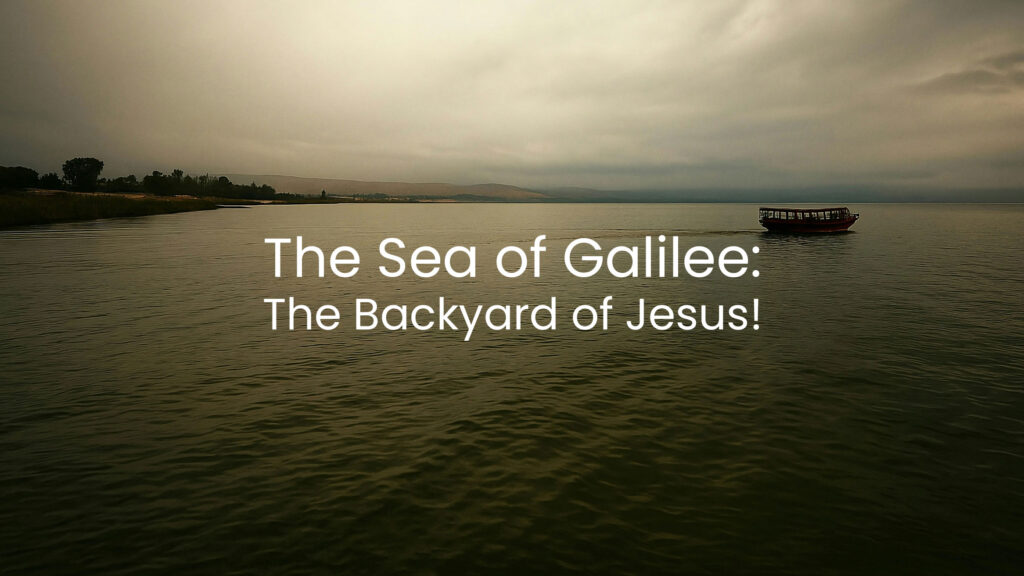
The streets of Jerusalem that Jesus walked are buried under centuries of rubble and stone. Many locations mentioned in the Gospels are hidden beneath layers of history, making them difficult to visualize. But when you look at a sunset on the Sea of Galilee, the centuries vanish. You are standing in the exact same place, looking out at the same waters, seeing the canvas of colors that Jesus saw.
Of the four tours I’ve had the privilege of leading to Israel, a highlight is always our time on the water of the Sea of Galilee. We board a look-alike first-century wooden boat and sail out onto the waters. In the middle of the lake, the engines stop, and everything goes quiet. You feel like you could hear a pin drop from a hundred yards—and you probably could, if the pin wasn’t dropping on water.
In that stillness, we sing Amazing Grace. It’s a holy moment, made even more intense when other boats are singing Amazing Grace as well. The harmonies drift across the water in an uplifting chorus. It is the ultimate song for this place, dedicated to the Author of Grace–Jesus–whose ministry flourished on and around this lake over 2000 years ago.
It is a relatively small lake (13 by 8 miles)—especially compared to the massive Great Lakes of the U.S.A. —but its size is incredibly deceptive. Because it sits more than 700 feet below sea level and is surrounded by steep hills, it acts as a geographic funnel. Cold air from the heights regularly collides with the warm, trapped air of the valley, capable of whipping up sudden, violent storms that can quickly produce waves six to 10 feet tall.
If the apostles had mobile devices back then, the Galilean video feeds would quickly go viral. We would have seen shaky-cam footage of Peter stepping off the side of a boat into the tempest, taking a few bold steps on the water’s surface, and then suddenly sinking into the swells.
It was right here on these northern shores, using the fishing village of Capernaum as His ministry base, that Jesus spent most of His three-year public ministry. In fact, of the roughly 40 miracles recorded in the Gospels, nearly half—along with dozens of His teachings, like the Sermon on the Mount on the surrounding hills—took place on this small pocket of lake and land.
Jesus’ choice of Capernaum wasn’t accidental.
Because of unique geological features, including underwater hot springs and nutrient-rich volcanic runoff, the lake’s northern shore was one of the most intense natural fish hatcheries in the ancient world. In just a few square miles, this small section of the lake produced hundreds of tons of fish annually. It was a bustling, high-production commercial hub. This bounty didn’t just feed local villages; it was salted, pickled, and shipped throughout Israel and across the Mediterranean to Rome, where it was prized as a delicacy.
What makes sailing this lake so deeply impressive is the sheer proximity of everything. From a boat just a short distance offshore near Capernaum, you can turn your head and take in the entire landscape of the Gospels at a single glance.
Look to the eastern cliffs, and you can see the region of the Gadarenes, where Jesus stepped off a boat and delivered the demonic man. Turn slightly, and your eyes land on the sloping hill of the Mount of Beatitudes, where the Sermon on the Mount echoed across the grass. Just a short distance down the western coast sits Magdala—a town whose very name means “the place of salted fish”—where Jesus delivered Mary Magdalene from seven demons.
In this place, Jesus lived, breathed, and called His disciples to follow Him. When you watch the sun sink below the Galilean hills, you aren’t just looking at history. You are looking at the backyard of Christ our Lord.