|
Getting your Trinity Audio player ready...
|
Let your speech always be gracious, seasoned with salt, so that you may know how you ought to answer each person (Colossians 4:6, ESV).
“Theology” is a term used to describe and define differing topics in the Bible.
Jesus, Paul, John, or Peter (or any other author of the New Testament) didn’t systematically list important Biblical themes with explanations for each, so theologians have developed systematic theology for centuries. Within their books (and more current podcasts), we can learn their viewpoints on the Trinity, salvation, the end times, the Holy Spirit, and many other topics.
I get excited reading these books, and you don’t, so I’ll stop writing about “systematic theology” now and start yammering about my “personal theology.” We all should have a personal theology.
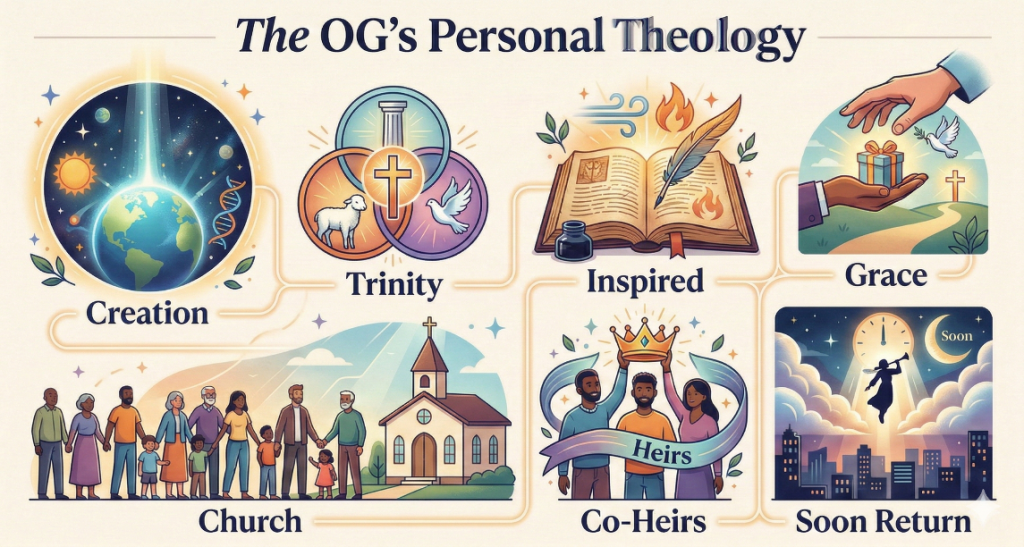
We should know these seven points of foundational Biblical teaching (theology), and let the beliefs impact the way we live in our “personal theology”:
One: We must believe that God created the universe and that creationism has become increasingly more defensible in recent years, while the alternative of naturalism keeps sinking into a quicksand of difficulties from recent scientific discoveries.
Two: We must believe that God exists as Father, Son, and Spirit. That while the term “trinity” can’t be found in the Bible, the Bible explicitly teaches that the Father, Son, and Spirit are eternal, all-knowing, ever-present, and all-powerful — or three distinct beings, all defined in the Bible as God, and so unified they can be considered One!
Three: We must believe that the Bible (Old and New Testaments) is God’s inspired Word that has been faithfully preserved through thousands of years of history. So, when you pick up your favorite translation (some much better than others), you are reading God’s Word.
Four: We must believe that we are saved by grace and not by works, and that Christianity is a relationship motivated by loving God and others, and not a religion of dry and meaningless rituals.
Five: We must believe that the body of Christ is the church. It contains sinners who live, exemplifying holiness and bringing glory or dishonor to God (and other Christians) through their sin. And yet every believer is a member of Christ’s body, the church.
Six: We must believe that we are children of God and co-heirs with Christ for God’s current and eternal purposes. That we are filled with the Spirit for power and maturity to obey Jesus.
Seven: We must believe in the soon return of Jesus, that everyone will stand before God the Father on a Day of Judgment in which our actions and thoughts will be clearly known and we will receive judgment accordingly, and that EVERYONE, to enter heaven, must have confessed Jesus as Lord and Savior while on earth. And those entering heaven will receive a reward according to their actions on earth.
There you have it, my “OG Personal Theology.” In 500 words, I couldn’t spend chapters dicing theological minutiae with the definition of terms. I just wanted you to know what I believe.
I think you should believe it as well, and it should be your “personal theology” too.