
|
Getting your Trinity Audio player ready...
|
Now after the Sabbath, toward the dawn of the first day of the week, Mary Magdalene and the other Mary went to see the tomb (Matthew 28:1, ESV).
Now when he rose early on the first day of the week, he appeared first to Mary Magdalene, from whom he had cast out seven demons (Mark 16:9).
But on the first day of the week, at early dawn, they went to the tomb, taking the spices they had prepared (Luke 24:1).
Now on the first day of the week Mary Magdalene came to the tomb early, while it was still dark, and saw that the stone had been taken away from the tomb (John 20:1).
Have you ever wondered why the date of Easter changes yearly? For over 55 years, I’ve asked that question too. You would think that as a pastor, I would have figured out the formula for the date and had it ready for my own calculations, and as a ready answer to anyone who asked why the date changes.
But I haven’t, which means I keep asking my administrator every year when Easter is. Recently, I was dumbfounded when someone asked me (as an assumed authority) why it changes yearly. I repented and researched why it’s a different date.
I now know, but since I’m not a pastor anymore, no one has asked the question. So, let’s imagine all of you sent me an email last week asking, “Assumed Authority Pastor Grant, why does the date of Easter change every year?”
Here’s my answer:
All four Gospel writers agree on “the first day of the week.” We also know it was Passover week (John 19:14-19, ESV). Those who are really authorities in these matters calculate that the best dates for the Passover of Jesus’ crucifixion would be April 3, A.D. 33 (which, ironically, has three 3s for the Trinity).
Early in church history, some believers celebrated Easter on the same day as Passover, while others celebrated it on the first Sunday after Passover. Adding to this “celebrated on two differing days” confusion, the Jewish Passover changed yearly because it followed the lunar calendar, which shifts about 11 days each year. The lunar calendar is shorter than our solar-based calendar, having just 29.5 days per month, or about 354 days, rather than our 365 days, meaning that every two to three years, the Jewish calendar would add a month.
We know that God is not the author of confusion, and with churches batting around two differing days along with a shifting lunar calendar that added a month every now and then, something had to be done.
Enter this formula calculated at the Council of Nicaea in 325 A.D.: Easter will be celebrated the Sunday after the first Paschal Full Moon following the vernal equinox. Now, using the vernal equinox (the first day of Spring), which can fall on March 19 to 21, the church selected the 21st to start the calculations.
All we have to do is define a Paschal Full Moon, which might not be a real full moon, but an ecclesiastical full moon, determined by the Metonic Cycle, a 19-year cycle of moon phases. And to be honest, I was still confused, so I asked Alice (my AI Assistant) to determine upcoming dates, and she said that Easter will be on March 28 in 2027 and April 16 in 2028.
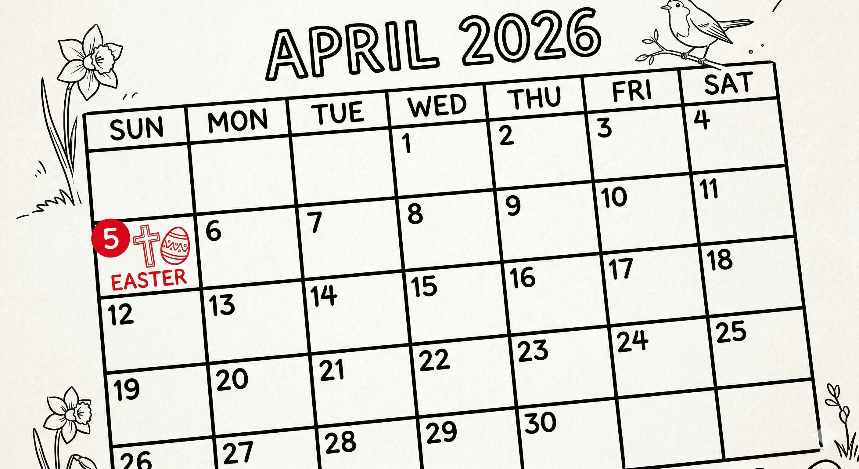
I’ve already instructed her to mark my calendar. And in case you didn’t mark your calendar, Easter is this Sunday, April 5!
He is risen!