
|
Getting your Trinity Audio player ready...
|
Blessed is the man who walks not in the counsel of the wicked, nor stands in the way of sinners, nor sits in the seat of scoffers; but his delight is in the law of the Lord, and on his law he meditates day and night (Psalm 1:1-2, ESV).
When I write my series, Psalms on Saturday, I look through my notes to find a Psalm that I haven’t written an Interruption about, and then I’ll write on that Psalm. I’ve had to look more closely in the past few months because the number of Psalms left has been decreasing.
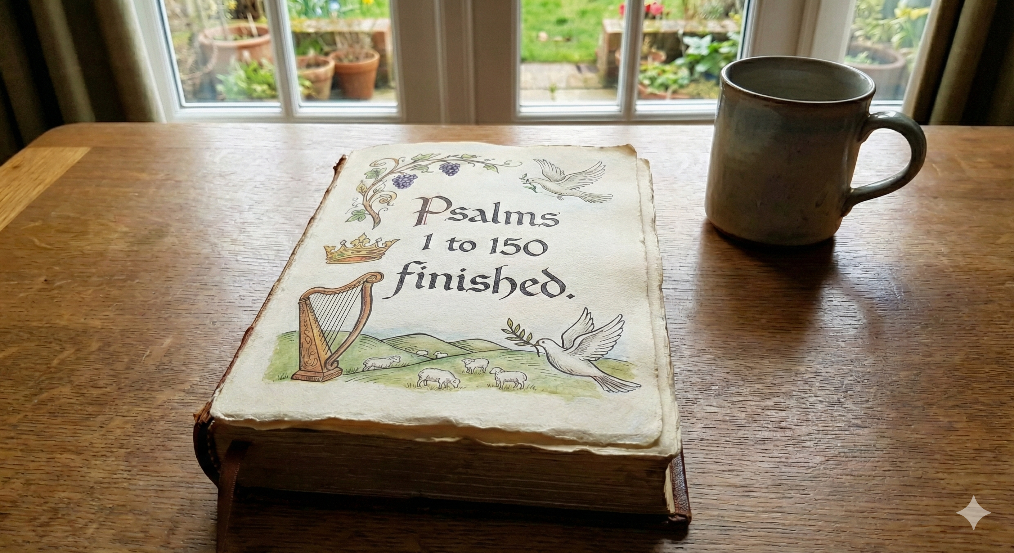
Today, it happened. I ran out of Psalms, not finding one Psalm that hasn’t been titled in a Psalms on Saturday. After three years, I’ve written on each of the 150 Psalms.
Realizing there were no more Psalms left, I felt a sense of accomplishment (and panic). I always had a topic on Saturdays. I loved writing about the Psalms, and now I don’t know what will appear in Interruptions next Saturday.
I’ve learned a lot from writing the Psalms. Below are some of my insights…
- The Psalms are among the oldest poems in history and cover a wide range of topics. There is nothing in life that a Psalm won’t help. And one Psalm has brought more healing to people than any other. The Psalm? It opens with, “The Lord is my shepherd, I shall not want.” (I don’t need to give you the number as you already know it.)
- Most ancient poems lose too much in translation because their content does not translate well into another country, culture, or age. But the Psalms bypass this translation difficulty by using images that everyone recognizes. Consider Psalm 1:3a: “Like a tree planted by streams of water,” or “My soul thirsts for you … in a dry and weary land where there is no water” (Psalm 63:1).
- Psalms express thoughts that we can’t. We struggle to find the right words for our thoughts, and then we read a Psalm and think, “That’s what I wanted to say.” The Psalms know and express what’s just beyond the tip of our tongues (this is divine inspiration). Consider the helpfulness of this phrase when considering life: “As for man, his days are like grass when the wind passes over it, it is no more, but the steadfast love of God is from everlasting to everlasting” (Psalm 103:15-17).
N.T. Wright, in his book entitled The Case for the Psalms, poses this question:
“What if the Psalms turned up a just-discovered manuscript, having not been seen or read for centuries? The discovery would be proclaimed through paper and social media, and thousands of scholars and Bible teachers would marvel at the beauty and practicality of these writings.”
Amen, N.T. Wright.
Hopefully, we’ve discovered the Psalms anew during the past three years and have been blessed.
Amen. Peace out! (Note: I ended most of my “Psalms on Saturday” Interruptions with this line. A little melancholy here, but is this the last time I write this phrase?)
I doubt it. Too much hippie in your past lol.