
|
Getting your Trinity Audio player ready...
|
For the word of the cross is folly to those who are perishing, but to us who are being saved it is the power of God (1 Corinthians 1:18, ESV).
Easter focuses on the resurrection of Jesus, as it should. He has risen, and you should be thinking, “He has risen, indeed!” But let’s not forget the cross; without it, the resurrection means nothing.
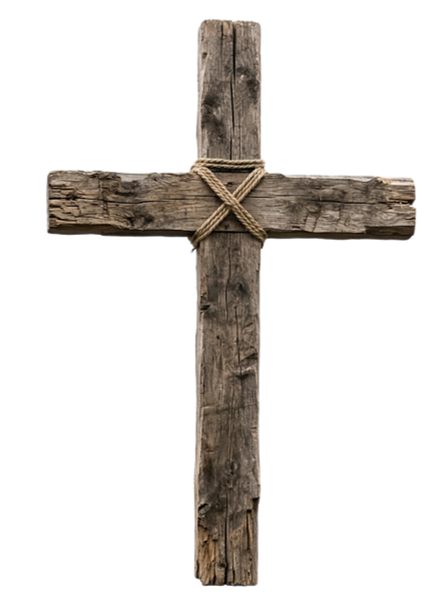
The cross has become the universal symbol of Christianity. Other objects could have vied for the centerpiece of the Christian faith — a carpenter’s bench, a dove (now the second-most-used Christian symbol), a chalice, a manger, and many others. What’s surprising is that, from the second century onward, the cross became the primary symbol of Christianity.
Tertullian (think: smartest theologian of his time) wrote in 200 A.D. about how the tradition of the cross had become embedded in the daily lives of Christians…
At every forward step and movement, at every going in and out, when we put on our clothes and shoes, when we bathe, when we sit at table, when we light the lamps, on couch, on seat, in all the ordinary actions of daily life, we trace upon the forehead the sign of the cross.
The Romans and Greeks in the first century considered crucifixion an abomination, with it being illegal to crucify a Roman citizen. The Jews thought that those crucified must be the sinners of sinners, deserving such a death. As John Stott (think: great theologian who died in 2011) writes…
Whether their background was Roman or Jewish or both, the early enemies of Christianity lost no opportunity to ridicule the claim that God’s anointed and man’s Saviour ended his life on a cross. The idea was crazy.
The only way a “cross” gets voted the motto of history’s most influential religion, as John Stott also writes…
The fact that a cross became the Christian symbol, and that Christians stubbornly refused, in spite of the ridicule, to discard it in favour of something less offensive, can have only one explanation. It means that the centrality of the cross originated in the mind of Jesus himself.
The idea of Stott, that the usage of a cross and not the other options came from Jesus Himself, in and of itself, is as unbelievable as the cross itself. How many of us would choose the moment of our humiliation, our most insignificant moment, the time when everyone ridicules us as the singular event by which we are remembered?
Mark says in his gospel that Jesus began to teach plainly that the Son of Man must suffer many things (Mark 8:31). In many conversations, Jesus spoke of “the day” and “his time” and “betrayal,” all of which became clear to His disciples the type of death Jesus must suffer. When comprehending this, Peter rebuked Jesus, to which Jesus responded by saying to Peter, “Get behind me, Satan!” (Mark 8:33a)
Writing later, Paul explains…
But emptied Himself, taking the form of a bond-servant, and being born in the likeness of men. And being found in appearance as a man, He humbled Himself by becoming obedient to the point of death: death on a cross (Philippians 2:7-8, NASB, emphasis added).
The central image of Jesus’s ministry is not of victory but defeat and humiliation, a caricature of the total inadequacy of anything of the flesh achieving victory, and that our enemy, death, can only be defeated by a perfect sacrifice on a cross.
Thus, this symbol…