In recent years, the global economy has felt increasingly volatile. According to the Bible, these events are signs of an approaching latter-day economy — one marked by increasing intensity and frequency of tribulation.
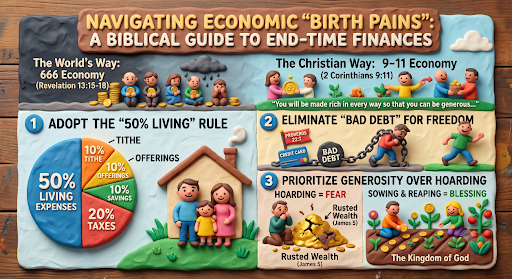
While the world often reacts to economic uncertainty with fear or hoarding, the Biblical perspective offers a radical alternative. The “666 economy” described in Revelation points toward a future of total state control and a one-world monetary system. In contrast, Christians are called to live in a “9-11 economy,” based on 2 Corinthians 9:11: “You will be made rich in every way so that you can be generous on every occasion.”
Understanding that the Bible foretells these shifts allows us to move from being “caught unaware” to being strategically prepared. Here are three practical steps you can take to maintain healthy finances in the end times.
1. Adopt the “50% Living” Rule
One of the most radical suggestions for financial health is to restructure your life to live on 50% of your gross income. Let’s take 100% of what you make and break it down into these percentages: 10% tithe, 10% offerings, 10% savings, and 20% for taxes. This leaves 50% for living expenses.
While this may seem impossible, it creates a “built-in safety net.” If the economy takes a 50% downturn, those already living on half their income are prepared to survive without panic. Achieving this requires the principle of deferred gratification, choosing to wait, save, and do without immediate luxuries to ensure future security and spiritual freedom.
2. Eliminate “Bad Debt” to Reclaim Freedom
Proverbs 22:7 warns that “the borrower is the slave of the lender.” In an end-time economy, being “enslaved” to credit card companies or high-interest loans limits your ability to follow God’s leading.
Healthy finances require a clear distinction between “good debt” (investments in things that appreciate, like a modest home or education) and “bad debt” (borrowing for depreciating luxuries like vacations or electronics). To be ready for the “birth pains” of the future, prioritize paying off credit cards and living within — or below — your means. True prosperity isn’t about how much you can borrow; it’s about the freedom to serve God without the weight of interest payments holding you back.
3. Prioritize Generosity Over Hoarding
It is a spiritual paradox: the world says we become rich by keeping; the Bible says we become rich by giving. In James 5, we are warned that hoarding gold and silver in the “last days” is futile because wealth can rot or become a target during social unrest.
Instead of hoarding, we should practice the principle of sowing and reaping. By tithing and giving offerings, we move our “investments” from a crumbling worldly system into the Kingdom of God. Generosity breaks the power of greed and fear over our lives, transforming us into “conduits” of God’s blessing. As the world’s currencies fluctuate, an investment in the Gospel is the only one guaranteed to hold eternal value.
Conclusion
The goal of understanding end-time finances isn’t to create a “bunker mentality.” It is to cultivate contentment. When we simplify our lives, eliminate debt, and practice radical generosity, we find peace that isn’t dependent on the Dow Jones Industrial Average. Our ultimate hope isn’t in a 401(k), but in the God who promises to provide for our every need.
Let’s summarize with this …