|
Getting your Trinity Audio player ready...
|
Then I saw in the right hand of him who was seated on the throne a scroll written within and on the back, sealed with seven seals (Revelation 5:1, ESV, emphasis added).
Beginning in chapter 5, we start what some call the “real” book of Revelation. Not that the letters to the seven churches and the throne room of God (chapters 1-4) are inconsequential, but let’s face it — we want the end-of-time IMAX® surround-sound version of chapters 5 through 22.
Patience — we begin that next week.
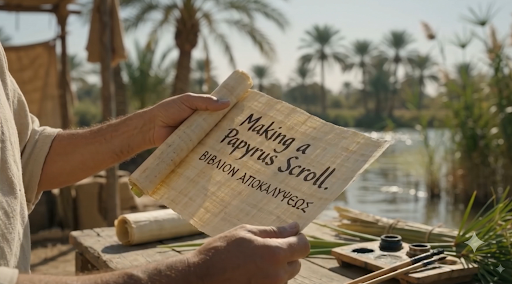
For this Interruption, we are going to focus on the actual scroll mentioned in Revelation 5:1 and how it was made or how the writing material for the original books of the New Testament was made. Today, we write on paper, but in the first century they wrote on papyrus. Today, we go online to Amazon® and fill out an order for 20# paper, and it’s dropped off on our front porch tomorrow.
Back then, they made a type of paper from the papyrus plant that grew along the Nile River. The actual copies of the New Testament written by Matthew, Mark, Luke, John, Paul, Peter, James, and Jude were written on papyrus.
How was it done?
Thin strips would be cut from the plant and laid in two layers at right angles to one another — one layer vertical and the other horizontal. Then a papyrus-maker would add glue and water and press a stack under something heavy like a rock.
These individual sheets, when dried, would then be glued together — sheet after sheet — until there was a scroll long enough to write the book. At nine to ten thousand words long, it would take about 20 sheets of papyrus, forming a scroll 12 feet long for the Book of Revelation.
We make books today with pages stacked and binding on the side. We now understand how Christians, who revered the books of the New Testament, were instrumental in popularizing the codex form of writing, which enabled easy reference to various passages of the New Testament, as you didn’t have to roll through 6 feet or more of scroll to get to chapter 11 of the Book of Revelation. It’s a lot easier to just turn pages.
In review of how scrolls were made:
- Harvest the papyrus plant from the Nile
- Cut the papyrus plant into thin strips
- Layer and glue strips vertically and then horizontally (easier to write on the horizontal side, though Revelation 5:1 says the scroll was written on both the front and the back sides)
- Place a large rock on top of a stack of freshly glued pages
- Take out the dried stack and smooth and polish the surface for ease of writing
- Glue individual sheets together to form a scroll
Or just live in 2026 and order from Amazon for overnight shipping!!! Click on this photo for a link to a video made by the film producer “OG” explaining the process.