
|
Getting your Trinity Audio player ready...
|
Moreover, it is required of stewards that they be found faithful (1 Corinthians 4:2, ESV).
The first verse that I memorized was Romans 13:14 …
But put on the Lord Jesus Christ, and make no provision for the flesh in regard to its lusts (NASB1995).
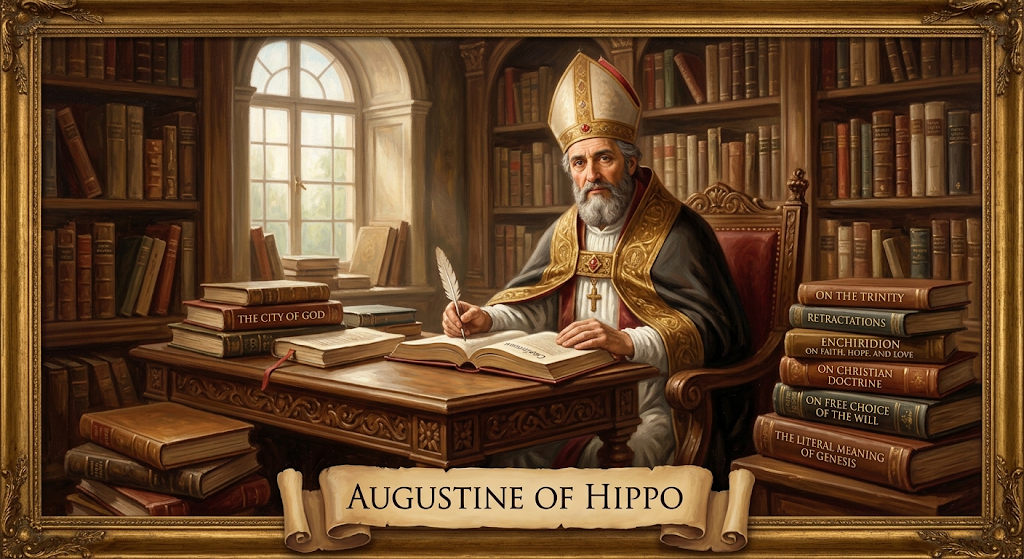
Reading about the great theologian Augustine (354-430 A.D.), I learned that though living a pagan lifestyle before becoming a Christian (just like me), he also had a mother who prayed for him (just like me), and then the Lord intervened (just like me). While I was baptized in the Atlantic Ocean on New Year’s Eve 1971/1972, Augustine’s conversion occurred while walking through a garden; he heard a child’s voice say, “Take and read.” Hearing this voice, Augustine picked up an epistle of the Apostle Paul, opened the book at random, and read…
Let us behave properly as in the day, not in carousing and drunkenness, not in sexual promiscuity and sensuality, not in strife and jealousy. But put on the Lord Jesus Christ, and make no provision for the flesh in regard to its lusts (Romans 13:13-14, NASB).
Again, just like me — Romans 13:14. Then we both became pastors.
But unlike me, Augustine became one of Christianity’s most influential theologians. He formulated the doctrine of original sin, teaching that because we are inherently fallen, we can be saved only by grace. He explained the Trinity in ways no other scholar had before him, and his view of knowledge (how we learn) laid the foundations for Western thought with his “Scholastic Method.”
Some of his famous quotes…
- You have made us for yourself, O Lord, and our heart is restless until it rests in you
- Love completely, and then do what you will
- Believe so that you may understand
- God loves each of us as if there were only one of us
After Augustine’s conversion, he moved to northern Africa and became the Bishop of Hippo. From Hippo, he wrote extensively, including Confessions (actually 13 volumes), where he examines his sinful self and his enlightenment as a believer, including profound meditations on knowing God.
In Esther 4:14, we read of Mordecai encouraging Queen Esther, as the existence of the Jews is threatened, that Queen Esther was alive “for such a time as this,” as encouragement for her to appeal to the King. Augustine also lived in a historic “such a time as this,” as Rome had been sacked by the Vandals, with many blaming Rome’s defeat on its contamination by Christians. In his magnum opus The City of God, Augustine decoupled the destiny of Christianity from the political fate of the Roman Empire, giving a theological view of history that taught believers to be citizens of heaven while temporarily residing as pilgrims on earth.
The Germanic Vandals didn’t stop at Rome but kept coming until they surrounded Hippo. Three months after the siege began, Augustine contracted a fever and died two weeks later. While on his deathbed, his scribes wrote and hung various Psalms on his walls as Augustine spent hours in penitent prayer.
I conclude with an interesting note that testifies to God’s providential ways.
Augustine wrote profusely, and his writings (many volumes) include over five million words (I have only three million), which he scribed with ink and quill and housed in the cathedral where he was bishop.
When the Vandals finally breached the walls of Hippo, all the major buildings of the city were burned except Augustine’s cathedral. Recognizing Augustine’s genius, the Vandal generals ordered his church, house, and library spared.
Thus, the great theologian’s thoughts — the foundations of Western society and spirituality — were spared by God.