

|
Getting your Trinity Audio player ready...
|
All Scripture is breathed out by God and profitable for teaching, for reproof, for correction, and for training in righteousness, that the man of God may be complete, equipped for every good work (2 Timothy 3:16-17, ESV).
For years, I’ve heard preachers and Bible teachers claim that the King James Version (KJV) is the only English translation worthy of reading. Listening closely to some of them, you get the impression that the KJV itself is the only inspired version of the Bible—which is interesting, considering the original Scriptures were written in Hebrew, Aramaic, and Greek.
So, is it the King James Version and no other? To answer that, let’s look at how we actually received both the KJV and modern English translations. For simplicity, I’ll focus on the New Testament, since it was written and collected under different circumstances than the Old Testament:
- The original writings of the New Testament authors.
- Handwritten copies (manuscripts) made from those originals over the centuries.
- Translations made from compiled Greek editions of those manuscripts, since the original autographs no longer exist.
Put simply, early believers recognized the 27 books of the New Testament canon (completing our 66-book Bible). Thousands of Greek manuscripts of those books survived, and scholars carefully compare them to reconstruct master Greek texts. From those Greek texts, translators produce Bibles in English, German, Russian, Urdu, Tagalog, and over 2,600 other languages that now have a New Testament. (And no, none of those languages have a “King James German” or “King James Russian”!)
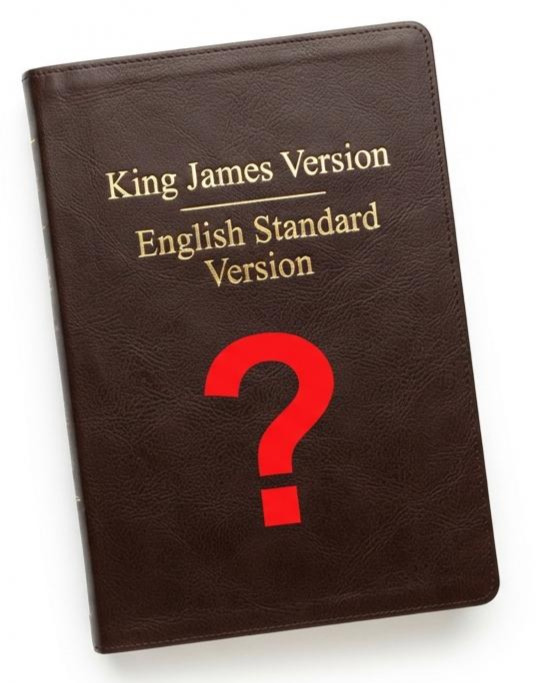
When the KJV was translated in 1611, its New Testament relied primarily on the Textus Receptus, a printed Greek text built from roughly a dozen late medieval manuscripts. By comparison, the English Standard Version (ESV)—which I often quote here in Interruptions—was first published in 2001 using the Novum Testamentum Graece (NA28) and United Bible Societies (UBS5) Greek texts, which evaluate evidence from over 5,400 surviving Greek manuscripts.
Supporters of the KJV argue that the Textus Receptus reflects a continuously preserved line of doctrinally uncorrupted medieval copies, whereas modern translations lean heavily on older 4th-century manuscripts that they view with suspicion.
Okay, enough with the manuscript debates and the “throw out the KJV or throw out the ESV” arguments.
If we actually read the KJV and the ESV side by side, we will quickly notice they say virtually the same thing, aside from the KJV’s “thees” and “thous” and a handful of minor footnotes. It is also worth noting that in both 1611 and 2001, translators faithfully worked from the very best Greek manuscripts available to them at that time. God has preserved His Word in a readable, trustworthy way in both translations, and no core Christian doctrine changes between them.
To our brothers and sisters reading in German, Russian, Urdu, or Tagalog: forgive us English-speakers. Sometimes we love to dot our i’s and cross our t’s a little too much.