

|
Getting your Trinity Audio player ready...
|
I praise you because I am fearfully and wonderfully made; your works are wonderful, I know that full well (Psalm 139:14, NIV).
On October 6, the Nobel Prize in Physiology or Medicine was awarded to Karl Deisseroth from Stanford University (along with two other researchers from Germany), who learned how to — get this — place tiny gates on brain cells.
Yep, think of your brain as a New England white picket fence that now has a gate. Before Karl’s work, science had only the picket fence with no gate. When they needed to enter the yard just behind the fence, they had to knock down the entire fence. Aren’t the guinea pigs (and eventual humans) in Karl’s lab glad there’s finally a gate?
Pastor Grant Explains Brain Science
I realize you might be a bit confused so far. Before I knock down your picket fence with unfathomable ideas, let me explain further.
First, the brain functions through neurons that communicate with one another via electrical charges. If scientists wanted to examine a malfunctioning brain in the past, they used electricity. It wasn’t very directed or specific, so they would end up lighting up an entire region of the brain — essentially knocking down the whole fence just to look at the yard.
But Karl and his German scientific buddies studied green pond algae that responded to light. Noticing a tiny gate on the algae cells that opened with light to direct them toward light for photosynthesis, they figured out an incredible trick. They took the blueprint for the gate, grafted it into a target area of the brain, hit it with blue laser light, and noted that only the newly gated cell and the pathways connected to it responded.
They could now enter the yard of a New England cottage without knocking down the fence.
What Makes Neurological Gates So Important
The human brain contains roughly 86 billion neurons — cells that enable all communication in our bodies (though some days it feels like we are only using a fraction of them!). Without guidance, firing an electrical charge can light up billions of cells simultaneously. But with these new gates installed, doctors can charge a single, isolated cell and observe its specific connectivity. This allows game-changing research into complex disorders like Parkinson’s disease, depression, and even blindness.
HHHHMMMHHM, I know we are all thinking, “Can the section of the brain that allows us to remember where we placed the car keys be recharged?” The ultimate answer (either with a few more years of research or when we get to heaven) is — YES!
Darwin and Evolution Take A Right Hook to the Chin
This current research about the brain agrees with the Psalmist who wrote, “I praise You because I am fearfully and wonderfully made.” Charles Darwin’s theory of evolution hinges on a gradual, linear progression from simple to complex. In the 19th century, scientists viewed a living cell as nothing more than a simple blob of protoplasm. However, the research behind this year’s Nobel Prize (whether the discovering scientists understand this or not) debunks Darwin’s oversimplified narrative.
Every advance in neuroscience shows the brain is not a chaotic clump of tissue, but a highly synchronized, orchestrated symphony of bioelectric engineering. We find that cellular structure is not simple; it is irreducibly complex. The light-gated channels revealed in the brain require many specialized proteins to work together simultaneously and cannot be built through random, incremental stages over time, because the intermediate stages would serve no biological purpose.
(Okay, confession time: I had to ask “Alice,” my AI assistant, to help me phrase that last paragraph.)
But Alice, many scientists, and I now agree on this: the new gate in the fence shows that cutting-edge 21st-century research aligns perfectly with what the Bible first proposed in Psalm 139 thousands of years ago.
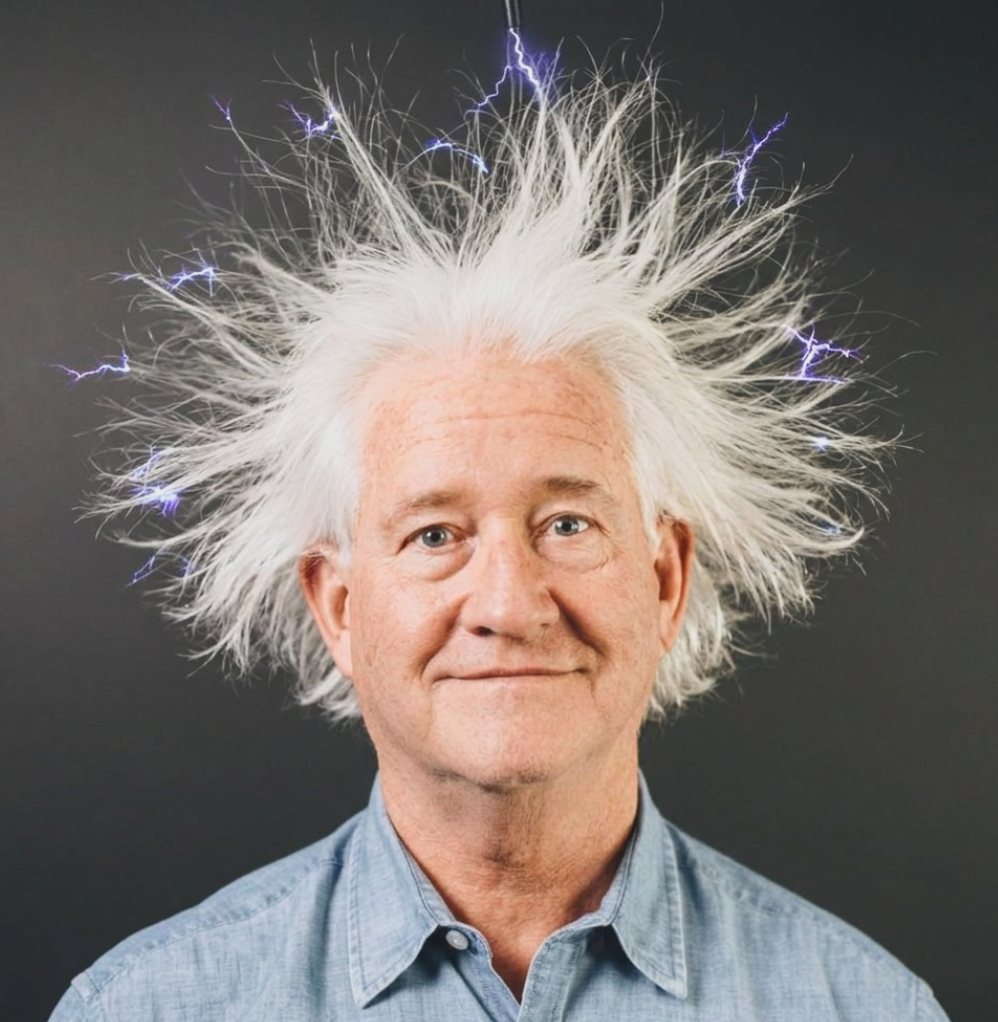
Pastor Grant after recent Nobel Prize experiments!