

|
Getting your Trinity Audio player ready...
|
We preach Christ crucified, a stumbling block to Jews and folly to Gentiles (1 Corinthians 1:23, ESV).
I want to introduce three non-Biblical and non-Christian friends from the first century — Josephus, Tacitus, and Pliny the Younger!
These three men are Reason #8 for the Reliability of the New Testament.
Why am I interested in three men who were not Christians, nor friends mentioned in the Bible, and probably persecuted or supported the persecution of Christians? They mention Christians and Jesus in their writings, corroborating statements from within the New Testament.
First: Josephus, who lived from A.D. 37 to 97
He was a prominent Jew who managed to avoid being killed by the Romans when they destroyed Jerusalem in A.D. 70. In fact, he seemed to be the favorite historian of Roman emperors, as his writings were popular and always portrayed these emperors favorably.
Josephus writes…
At this time there appeared Jesus, a wise man. For he was a doer of startling deeds, a teacher of people who receive the truth with pleasure. And he gained a following both among many Jews and among many of Greek origin. And when Pilate, because of an accusation made by the leading men among us, condemned him to the cross, those who had loved him previously did not cease to do so. And up until this very day the tribe of Christians (named after him) has not died out.
Josephus confirmed three Biblical truths: Jesus had many followers, He was crucified, and Jesus’s followers continued to believe even after His death.
Second: Tacitus, who lived from A.D. 55 to 120
As a member of the ancient Roman aristocracy, he provides an immense amount of historical detail about ancient Rome. Emperor Nero started a major fire in Rome in A.D. 64 to clear out the slums to expand his palace; the fire eventually burned three-fifths of the city.
To avoid blame, Nero blamed Christians. Tacitus reports…
Consequently, to get rid of the report, Nero fastened the guilt and inflicted the most exquisite tortures on a class hated for their abominations, called Christians by the populace. Christus, from whom the name had its origin, suffered the extreme penalty during the reign of Tiberius at the hands of one of our procurators, Pontius Pilatus, and a most mischievous superstition, thus checked for the moment, again broke out not only in Judaea, the first source of the evil, but even in Rome.
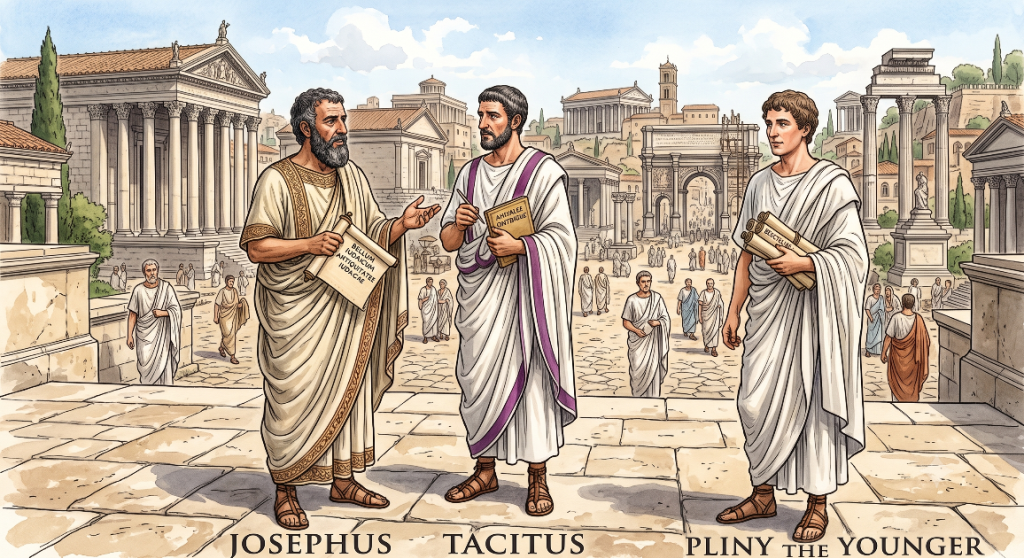
Tacitus also confirmed three facts from the New Testament: Christians were hated, Jesus suffered under Pontius Pilate, and Christianity had reached Rome.
Third: Pliny the Younger, who lived from A.D. 61 to 113
Pliny, a Roman ruler, wrote to Emperor Trajan on how to treat believers arrested for being Christian. One portion from his letter, I find fascinating…
The sum total of their guilt or error amounted to no more than this: they had met regularly before dawn on a fixed day to chant verses alternately among themselves in honour of Christ as if to a god, and also to bind themselves by oath, not for any criminal purpose, but to abstain from theft, robbery and adultery, to commit no breach of trust and not to deny a deposit when called upon to restore it. After this ceremony it had been their custom to disperse and reassemble later to take food of an ordinary, harmless kind.
Again, Pliny confirmed three things: Christians treated Jesus like a god, believers lived honorable lives, and he described believers gathering for worship, including the Lord’s Supper.
After reading Josephus, Tacitus, and good ol’ Pliny in seminary, I was fascinated not only by their corroboration of Christian beliefs but also by the fact that early Christianity was growing rapidly and believers were held in high esteem by non-believers.
Thanks, my three non-Christian friends; it wasn’t your intention, but you increased my faith!
Enjoyed this interruption and its historical background. We hear a lot about Josephus, but not the other two historical figures, each of which has provided important significance, especially since they were not Christian, thus significantly adding great believability to the historical record of Jesus and Christianity. If there were only one person from this era to write about this, non-believers might be able to refute the assertions more easily, but with three, as scripture says, “…in the voice of two or three witnesses,” these detailed descriptions, provide considerably more certainty to their validity. Further, the fact that they come from different time periods and were probably not contemporaries of one another, yet essentially agreeing on many of the same things, further adds to the undeniable historical record. We have heard a lot about Josephus and the Jewish wars, but now learning about two more witnesses, seals the case, as far as I am concerned.
Thanks for the enlightenment Grant!
Always appreciate your comments and insight Jim. We are in difficult but exciting Biblical times.