
|
Getting your Trinity Audio player ready...
|
Explained
Then I saw an angel coming down from heaven, holding in his hand the key to the bottomless pit and a great chain. And he seized the dragon, that ancient serpent, who is the devil and Satan, and bound him for a thousand years.— Revelation 20:1-2 (ESV)
There is an incredible amount of discussion surrounding just two verses in Revelation 20 and their mention of the Millennium. When it comes to discussing eschatology, a student of the Bible doesn’t progress very far without running into three prefixes: “a-,” “post-,” and “pre-.”
These prefixes give us amillennialism, postmillennialism, and premillennialism—even though the word “millennium” is not found anywhere in the original Greek of the New Testament or in early English translations.
Drop This Word at Your Next Party
The original Greek word for 1,000 years is chilia, and the earliest church scholars did not call themselves “millennialists” but rather “chiliasts.” So, the next time you are attending a party, and someone asks about your view of the end times, just say, “I’m an achilian, postchilian, or prechilian.” Though you might get some strange looks, you can smile knowing you know more of the original language than those throwing around the word “millennium.”
It wasn’t until the 4th century that Jerome translated the Greek New Testament into Latin. He utilized the phrase mille annos—combining mille (thousand) and annus (year)—providing the exact Latin blend from which the English word “millennium” was manufactured.
For the first three hundred years of church history, almost all scholars and church fathers held a traditional premillennial view, known back then simply as chiliasm. The structural categories of “a-,” “post-,” and “pre-” came along much later, giving theologians plenty of reasons to prove their scholarship by debating one another as the differing viewpoints developed, and also keeping publishers throughout church history in business.
Early Church Shifts: From Literal to Allegorcial
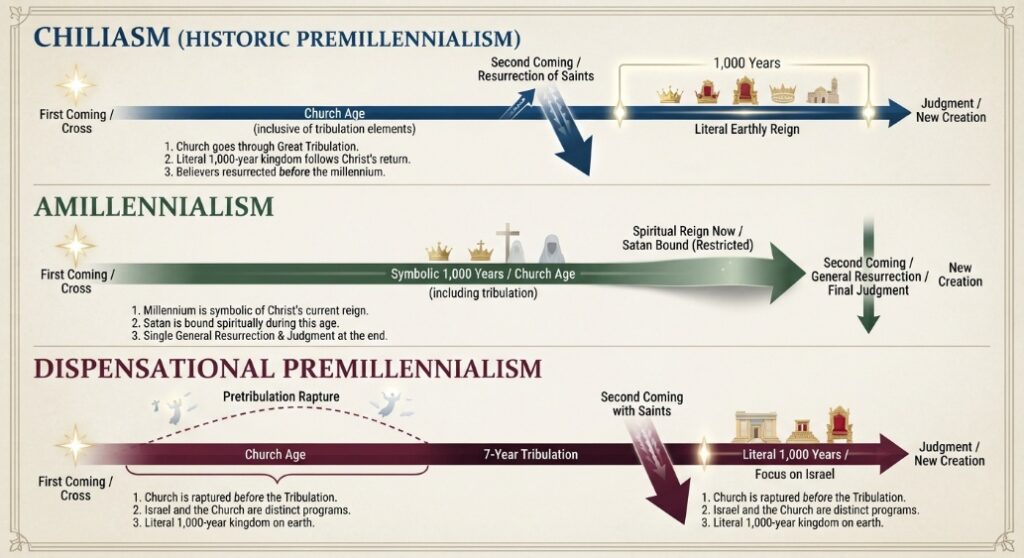
Early chiliasm taught a literal, physical 1,000-year reign of Christ on earth.
Amillennialism, on the other hand, began sprouting early through the allegorical teachings of Clement of Alexandria (150–215 AD) and Origen (185–254 AD). However, the view was truly legitimized by Augustine, who is widely recognized as the Father of Amillennialism. This newer framework explained that the “first resurrection” in Revelation 20:5 was actually the spiritual rebirth of a Christian, and that the 1,000 years symbolically represented the entire duration of the Church Age.
Two important historical notes about amillennialism: this structural blueprint for spiritualizing the text was heavily adapted from a system proposed by a Donatist (think heresy) named Tyconius (c. 390 AD). Augustine popularized Tyconius’s interpretive rules, ultimately identifying the Catholic Church as the figurative Kingdom of God on earth until Christ returns.
The Modern Era: The Rise of Dispensationalism
Fast forward to the modern era, and most premillennial churches today do not actually teach the historic chiliasm of the early centuries.
Instead, they teach Dispensational Premillennialism, which introduces a sudden, pre-tribulation rapture and treats the Church Age as a distinct era before a literal Jewish age in the millennium. By contrast, early chiliasm taught that the church would go directly through the Great Tribulation up to the physical return of Christ; they did not split God’s plan into two separate tracks for the church and ethnic Israel.
I’ve often heard critics of Dispensational Premillennialism claim that the view only started in the 1800s. That statement is both true and untrue. While dispensationalism itself is relatively modern, premillennialism as a foundational concept was the very first widely held eschatology of the Church—long before it was largely replaced by Amillennialism.
Today, the modern dispensational version has simply taken the driver’s seat with much of Christianity, promoted by a long line of influential scholars spanning from John Nelson Darby and C.I. Scofield to Charles Ryrie, Hal Lindsey, Tim LaHaye, and one of my personal favorites, David Reagan.
Well, I am officially out of word space for this blog post. I didn’t even get a chance to dig into postmillennialism! To be completely honest, the historical chronicle in this blog got a little out of control tangled up in “a-,” “pre-,” and “post-,” alongside “millennial” and “chilia.”
Please come quickly, Lord Jesus, and clear up all our confusion!
And check this illustration that might help explain the three viewpoints from my AI Assistant Alice.