

|
Getting your Trinity Audio player ready...
|
Now the sons of Israel again did evil in the sight of the Lord, so that the Lord gave them into the hands of the Philistines forty years (Judges 13:1, NASB1995).
If you were an Israelite in Biblical history, you would not want to hear the cry, “The Philistines are coming.” They were ferocious warriors and the Achilles’ heel of Israel. Mentioned about 300 times in the Old Testament, they were often allowed by God to invade and inflict punishment on the Israelites when the Jews wandered from faithfulness.
Those of us who watched the sitcom “Frasier” (not quite ancient history) remember the Crane brothers, Frasier and Niles, regularly using “philistine” to describe anyone beneath their self-imposed superiority. Nowadays, nobody wants to be called a philistine.
The name “Philistine” means “people from the sea,” and historians believe they originated in Crete and eventually settled in the three cities of Askelon, Ashdod, and Gaza. Today, with Israel occupying Ashkelon and Ashdod and the Palestinians in Gaza, this area of the world still incites violence between Israel and its enemies.
Note on this ancient map where Gaza, Askelon, and Ashdod existed in the time of King David, and the trade route from Egypt to Syria, passing through the coastal areas of Israel. The wealth created by this ancient highway, plus the difference in religions (Philistines ate pigs and dogs, and the Israelites didn’t), created tension for centuries.
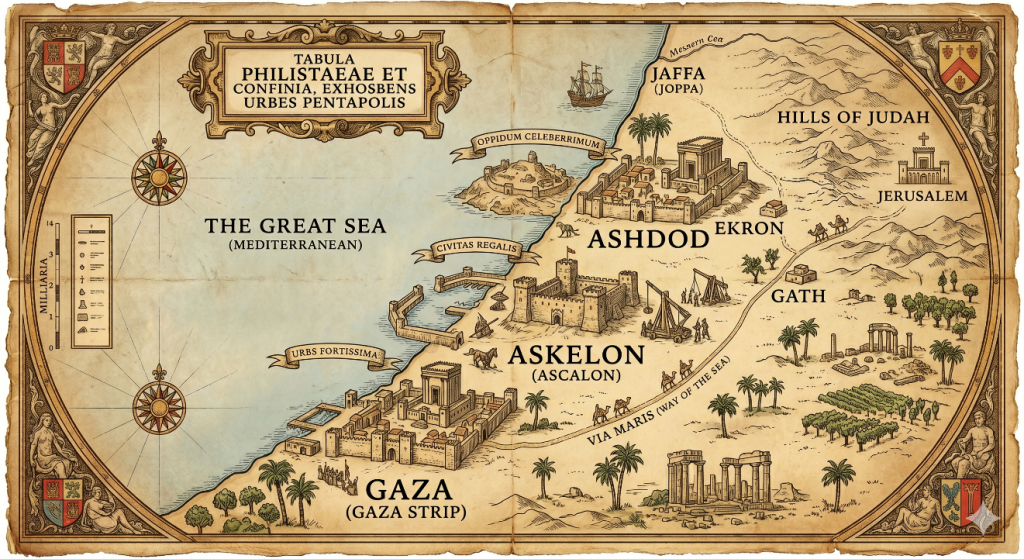
In Judges 13:1, we read, “And the people of Israel again did what was evil in the sight of the Lord, so the Lord gave them into the hand of the Philistines forty years.” Samson became the Israelite deliverer, but then Delilah, bribed by the Philistine leaders, seduced Samson into telling the secret of his strength, and after cutting Samson’s hair, shouted: “The Philistines are upon you.”
David, though, turned the tide of battle against the Philistines with his slingshot, while King Saul was killed by the Philistines in a battle on Mount Gilboa. In 1 Samuel 4, we see the Ark of the Covenant captured by the Philistines, resulting in their affliction with boils and tumors. Back and forth it went between the Philistines and the Israelites.
When the Jews rebelled against Rome in 135 A.D., the Romans removed the Israelites from the Promised Land, renaming it “Syria-Palestina” as an insult to the Jews, as “Palestina” meant “Philistines.”
However, the real Philistines, prophesied against in Amos 1:1-6 and Jeremiah 47:1-7, ceased to exist after the tribe of Judah was carried into Babylonian captivity — the Jews returned to a land delivered from the Philistines. The pagan Philistines, with their idol worship, were eliminated from Israel. The historical record shows that, with the Philistines gone, the Israelites never worshipped idols again.
Now the stage was set for Jesus to be born into a monotheistic culture. The Israelites, with their idol worship of various gods eliminated, could now worship the only living God.
But would they?