
|
Getting your Trinity Audio player ready...
|
Be patient, therefore, brothers, until the coming of the Lord. See how the farmer waits for the precious fruit of the earth, being patient about it, until it receives the early and the late rains (James 5:7, ESV).
In 1911, the population of Springfield, Ohio, was about 44,000. And during a six-week crusade in September and October, led by Billy Sunday, about 7,000 made decisions for Christ — that’s 16 percent of the population.
Dozens of churches participated in the revival, not holding Sunday services for six weeks, funneling people to the crusade, and as one newspaper article reported, “The revival systematically integrated almost all of Springfield’s mainstream Protestant churches.”
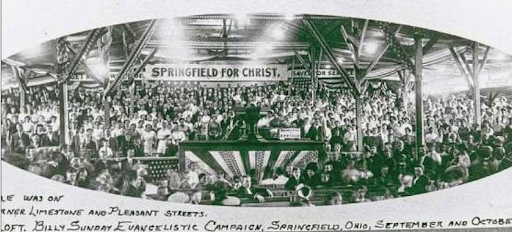
Billy Sunday’s temporary tabernacle in Springfield, Ohio.
For weeks leading up to the revival, hundreds of “cottage prayer meetings” were held in homes throughout the community. Billy Sunday’s team arrived months in advance to train churches in evangelism and to help locals construct an open-air wooden tabernacle close to downtown Springfield with a capacity of around two thousand.
Billy Sunday’s preaching included pacing, screaming, and even smashing of chairs, and at the end of a sermon he would suddenly lean over the pulpit, lower his voice, look directly at the crowd and say…
You know that God has spoken to you. You know that without Jesus you are lost!
Then, he would pause and continue…
How many of you men and women will jump to your feet, come to the stage and say, “Bill, I’ll take Jesus as my savior.”
And 7,000 responded.
As a pastor in my town for over 50 years, I’ve heard rumors that some churches doubled in attendance. There is a vacant, large Methodist church in Springfield with boards on hinges attached to the sanctuary walls that could be lowered to add seating after the pews were filled. This church increased its seating capacity to over 1,500 people, while other churches enlarged sanctuaries with a new church building breaking ground just a few months after the crusade.
Amazing that one of the largest building booms in 1912 and the few years afterward, in Springfield, Ohio, was new church buildings, expanded sanctuaries, and education wings. Newspapers recorded these two statistics…
- Weekly tithes and offerings doubled in churches throughout the city
- For multiple congregations, the size of youth groups doubled
Beginning with chapter two of the Book of Acts, revivals have consistently transpired throughout the history of the church. I’ve witnessed three revivals in Springfield, Ohio, during the Jesus Movement; in St. Petersburg, Russia, after the fall of communism; and in Cuba — and in all three thousands suddenly proclaimed Jesus as Lord.
James 5:7 talks about a latter-day rain, which I believe could be a last revival that impacts the church around the world. But note another reference to rain in James chapter 5…
Elijah was a man with a nature like ours, and he prayed fervently that it might not rain, and for three years and six months it did not rain on the earth. Then he prayed again, and heaven gave rain, and the earth bore its fruit (vv. 17-18).
I’m inspired after reading about revivals and think, “Do it again, Lord!” It’s no accident that James mentions rain twice in chapter 5. One, about a latter-day rain, and two, with Elijah (a man like us) who could call down literal rain, probably indicating that united prayers (by people like us) can seed this last latter-day rain of revival.
I’m praying.