|
Getting your Trinity Audio player ready...
|
In the beginning, God created the heavens and the earth. The earth was without form and void (Genesis 1:1-2a, ESV).
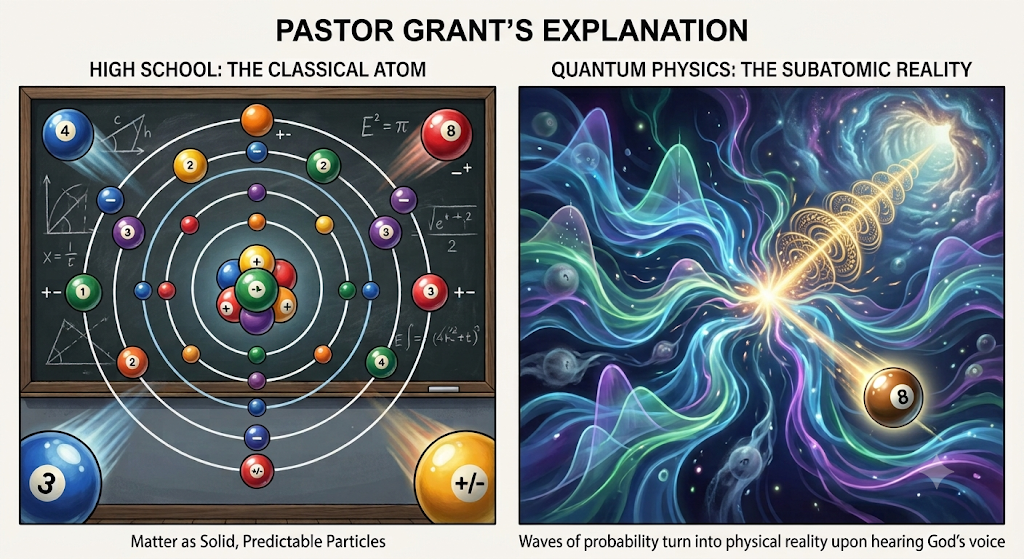
I was taught in high school physics that the universe was made of atoms and subatomic particles. Now, quantum physics dictates something entirely different — that the core elements of the universe are not atoms but waves and particles of energy.
I was also taught in high school chemistry that you could mix chemicals to form compounds with entirely different characteristics than the individual elements. In our high school chemistry class, a group of individuals (I’m not confessing to anything) took iodine crystals and ammonium hydroxide. Then we — oops, I mean some group of people — took the brown, gooey substance that resulted and sprinkled it in the hallways of our high school.
When that substance dried, it became a highly sensitive contact explosive. As students walked on it, explosions occurred! Not maiming explosions, just the incredibly loud, purple-smoke type. I can’t reveal what happened to that group of students when they visited the principal’s office, but I can say that due to the safety risks, creating this compound is now effectively banned in high schools nationwide.
HHHHMMMHHHM!
But back to the universe. Creation wasn’t a high school chemistry class gone awry, because modern physics teaches us something mind-boggling: before there were stable chemical compounds, the fundamental building blocks of the universe existed in a state of pure energy.
In high school, we were taught that the universe is made of solid, predictable little billiard balls called atoms. But quantum physics dictates something entirely different. It reveals that at the subatomic level, matter behaves like waves of fluid possibilities. In fact, quantum mechanics teaches that these fundamental waves have no definite position or concrete reality until they are acted upon by an outside influence. The moment an observer interacts with them, the wave “collapses” and snaps into a physical particle.
I’m not making this up!
Doesn’t this “new physics” sound strangely familiar to verses in Genesis 1? God said, “Let there be light” (v. 3). God said, “Let there be an expanse in the midst of the waters…” (v. 6).
We get the point from Genesis, but listen to the Psalmist:
By the word of the LORD the heavens were made, and by the breath of his mouth all their host (Psalm 33:6).
And Isaiah:
So shall my word be that goes out from my mouth; it shall not return to me empty, but it shall accomplish that which I purpose, and shall succeed in the thing for which I sent it (Isaiah 55:11).
And the Apostle Paul:
…in the presence of the God in whom he believed, who gives life to the dead and calls into existence the things that do not exist (Romans 4:17b).
Fortunately, the Psalmist, Isaiah, and Paul never had to take a high school physics class, as they figured out creation long before modern science. It is amazing to think that God created these waves of potential, and then, through His divine interaction, “called” our concrete universe into existence.
Albert Einstein famously struggled with these strange quantum concepts, dismissing some of the odd interactions between separated particles as “spooky action at a distance.” However, believers don’t need to be troubled by the mystery — we just praise the Author and Creator of the universe.
Well, that’s Pastor Grant’s explanation of the universe. Now, the only mystery left is whether I had anything to do with those exploding chemicals in high school. What do you think?