

|
Getting your Trinity Audio player ready...
|
When the centurion and those who were with him, keeping watch over Jesus, saw the earthquake and what took place, they were filled with awe and said, “Truly this was the Son of God!” (Matthew 27:54, ESV).
If you read through the New Testament, you will run into Roman centurions 24 times. Remarkably, every single time one appears in Scripture, he is portrayed in a positive light. That is surprising when you remember who these men were.
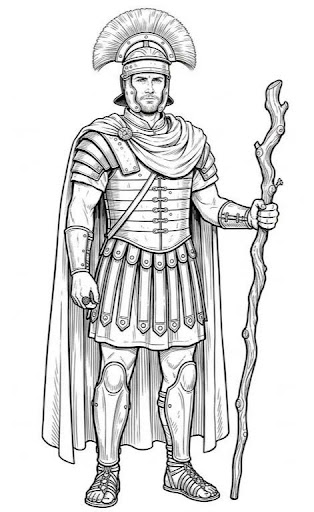
A centurion was the backbone of the Roman military, commanding roughly 80 to 100 soldiers. They were battle-hardened career officers promoted from the ranks for bravery and leadership. They also made serious money—often 15 to 20 times what an ordinary foot soldier earned. That kind of wealth explains how the centurion in Capernaum could afford to personally fund the building of a local Jewish synagogue (Luke 7:5), a detail fictionalized in The Chosen® when Gaius the Centurion helps repair the synagogue’s cistern.
Along with wealth came positional authority. Centurions carried a gnarled vine-wood staff to mete out instant justice on the spot. Talk back or march out of step, and you felt the wood. One notoriously harsh Roman centurion even earned the nickname “Cedo Alteram,” meaning “Fetch Another”—because he broke so many staffs over his soldiers’ backs.
Yet in the Gospels, these tough-as-nails commanders repeatedly humble themselves before Jesus. In Capernaum, a centurion begs Jesus to heal his dying servant, understanding chain-of-command authority so well that he trusts Jesus to heal from a distance with a single word (Luke 7:1-10). Jesus marvels that He hasn’t found such great faith in all of Israel. Later, standing beneath the cross as darkness falls and the earth shakes, another centurion looks up at the crucified Jesus and declares, “Truly this was the Son of God!” (Matthew 27:54)
Perhaps the most famous centurion story comes from early church tradition—a dramatic illustration rooted in the real fourth-century martyrdom of 40 Roman soldiers on a frozen lake. As the classic telling goes, a centurion named Vespasian commanded an elite unit of one hundred champion “wrestlers.” When an imperial decree demanded that Christians renounce their faith or die, 40 of Vespasian’s finest stepped forward.
Vespasian had fought alongside these men and couldn’t bring himself to swing the executioner’s sword. Instead, he ordered them stripped naked and marched onto the ice of a frozen lake, promising that a warm fire waited on the shore for anyone ready to deny Christ. Out onto the ice they marched, singing, “Forty wrestlers, wrestling for Thee, O Christ, to win for Thee the victory, and from Thee the victor’s crown.”
All night, Vespasian stood sleepless on the shore listening to them sing “Forty wrestlers…” as their voices grew softer and softer in the bitter cold. Finally, near dawn, one broken soldier crawled to shore. Yet instead of giving up, the remaining men lifted their voices with renewed enthusiasm: “Thirty-nine wrestlers, wrestling for Thee, O Christ!” Deeply convicted, Vespasian took off his clothes, declared himself a Christian, and ran out onto the frozen lake shouting, “Forty wrestlers, wrestling for Thee, O Christ!”
From Capernaum to Calvary to a frozen lake, these rugged commanders remind us that no armor is too thick for God’s grace to pierce.