

|
Getting your Trinity Audio player ready...
|
Since Christianity is a relationship, we can talk to God—in fact, He wants us to talk to Him. We call this prayer.
Yet prayer isn’t a one-way monologue from us to Him, nor is it Him dictating orders to us. Instead, we partner with God in a two-way conversation. As 1 Corinthians 3:9 reminds us, “For we are God’s fellow workers.” That partnership allows us to discern God’s will and ask accordingly.
What I just wrote points to the single most important aspect of our prayers. When I say “prayer” here, I don’t mean worship or adoration—though both are vital forms of prayer—I mean asking, since “ask” is used in connection with prayer more than any other word in Scripture.
We are commanded to ask. Still, simply asking isn’t the number one principle of fruitful praying. I once heard a pastor say that praise and thanksgiving are the most important parts of prayer, pointing out that Paul combines rejoicing, thankfulness, and making requests in Philippians 4:4–6:
“Rejoice in the Lord always; again I will say, rejoice. Let your reasonableness be known to everyone. The Lord is at hand; do not be anxious about anything, but in everything by prayer and supplication with thanksgiving let your requests be made known to God.” (ESV)
While our prayers certainly won’t thrive without rejoicing, praise, and thankfulness, even those aren’t the foundational key to answered prayer. So, what is most important?
Praying according to your calling.
I’m not saying asking according to our calling (or God’s will) replaces praise or thanksgiving, but it is essential for seeing requests answered. God’s will is a narrow path. If we wander off that path, our prayers asking Him to bless our detours won’t be answered. However, when we stay on His path and ask Him to remove an obstacle blocking our way, we unlock mountain-moving answers.
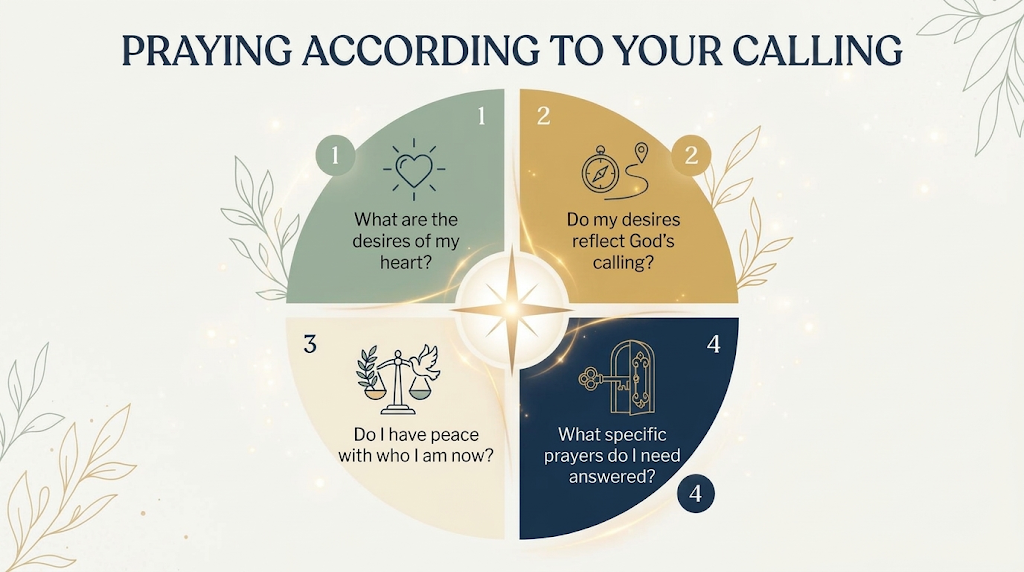
To help you pray according to your calling, pause and ask yourself these four questions:
- What are the desires of my heart? God often plants His purposes inside our deepest, sanctified passions.
- Do my desires reflect God’s calling? Checking our motives ensures we are chasing His assignment, not just personal comfort.
- Do I have peace with who I am now? Resting in your current identity in Christ keeps you from praying out of insecurity or comparison.
- What specific prayers do I need answered? Once your heart is aligned, you can bring bold, targeted requests to remove obstacles in your path.
These four questions align your desires with your calling, bringing deep peace and releasing bold faith. When you stop treating prayer like a spiritual vending machine and start aligning your requests with God’s design for your life, Heaven backs your words.
As A.W. Tozer famously said, “Outside of the will of God, there is nothing I want, and in the will of God, there is nothing I fear.” Similarly, Andrew Wommack challenges believers to seek God’s direction before rushing ahead, praying, “God, I’m not moving. I’m not doing anything else. I’m not wasting any more time until I find out what Your will is.”
It’s impossible to pray powerfully without knowing our calling, yet the majority of believers struggle to clearly define theirs. When Paul writes in Ephesians 4:1 that we are to walk in a manner worthy of our calling, the Greek word for worthy (axios) sounds just like our English word “axis.” That gives us a helpful picture of a central point—an axis—around which our entire calling revolves.
To walk and pray powerfully, our requests must swirl around the axis of our calling. And the gates of Hell will not stand against axis-driven prayers!
Take five quiet minutes today to sit with God and journal your answers to the four questions above—and watch how your prayer life grows.