
|
Getting your Trinity Audio player ready...
|
A few years ago, I was leading a touring group in Israel, visiting Caesarea Maritima, an ancient city built by Herod the Great about 15 B.C. This amazing city contained a stone shipping port built out into the Mediterranean Sea, an amphitheater that could hold 4,000 people, and Herod’s palace built out into the Sea on stone buttresses.
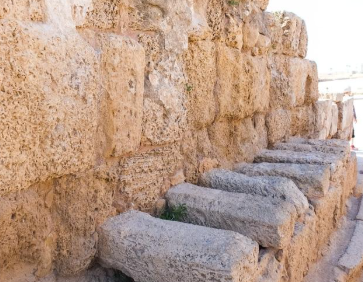
As we walked through the ruins of the city, the group rounded a corner to find a wall with carved stones sticking out, and slits between these stones with a channel under the seats for flowing water.
Our guide asked if anyone needed to use the restroom.
We had just stumbled upon a public toilet area, and in ancient Roman times, they were often very public. Here’s a photo of what we saw; note that it’s located in an alley, with no privacy walls between the stones.
They called it a communal bathhouse (restroom), and in my opinion this gives an entirely new meaning to the word “communal.” While researching this topic, I learned it was open-aired (probably a good idea), and people would sit on these stones for conversations, business meetings, and, I guess, when they felt a strong urge, they didn’t have to run to the bathroom like we do today.
HHHHMMMMHHM! Of course, a bunch of us sat on the stones for a photo-op, but with the public decency standards of this blog, I will not show that photo.
The Bible mentions restrooms, or latrines, several times. In the Old Testament we read…
And they demolished the pillar of Baal, and demolished the house of Baal, and made it a latrine to this day (2 Kings 10:27, ESV).
And Jesus referenced a latrine in this statement…
Jesus said, “Are you still lacking in understanding also? Do you not understand that everything that goes into the mouth passes into the stomach, and is eliminated? (Matthew 15:16-17, NASB1995).
The word “eliminated” in the Greek denotes the place where bodily waste was eliminated. However, large communal latrines of the Caesarea Maritima variety did not exist in Jerusalem because of Jewish purity laws, except for the Roman Garrison inside the Antonia Fortress, an elevated stronghold from which Roman soldiers kept a watchful eye on the Jews in the temple area. (Read about Paul and the Antonia Fortress in Acts 21:27-40.)
The Romans used human excrement from latrines to fertilize crop-growing land, passing along dung-based worms and parasites into food eaten later by the Romans. While the Jews, with laws prohibiting proximity to human waste, had much healthier and salmonella-free food.
Now back to the Romans’ latrines.
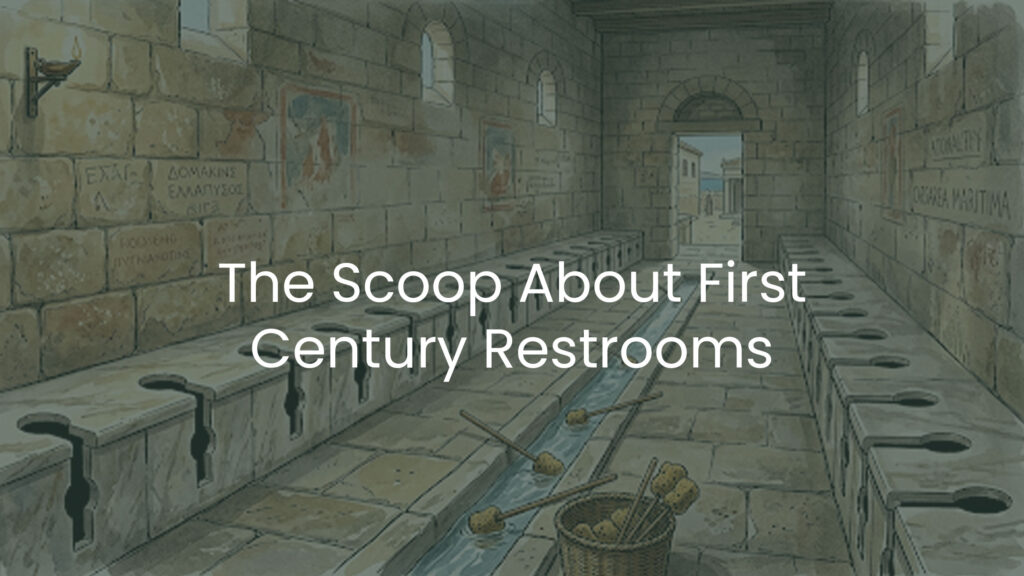
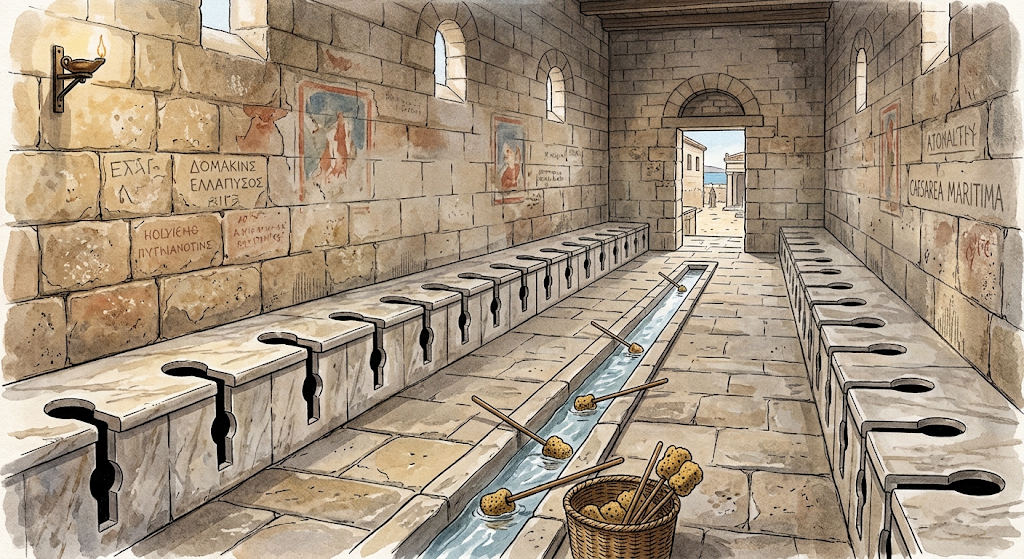
The communal toilets were mostly housed in a long room (with a roof), had continually running water under the commodes, and another stream of water in a trough in front of the seats that ran down the middle of the room. In this visualization, we see a type of cleansing sponge, since no toilet paper existed, and in some locations plant leaves and even rocks were used.
I realize this is a unique topic for today’s Interruption. I find it fascinating that the Jewish laws of sanitation and cleanliness in the Old Testament protected the Jews from germs and parasites thousands of years before the microscope allowed the discovery of what we know today about pathogens.
The hygienic practices of the Jews — along with Jesus and the apostles — are still followed today.